
Six Evils & Seven Emotions
Etiological (Causal Factors) in TCM
TCM holds that there are both opposite and unitary relationships between the organs and the tissues, and between the human body and the natural environment. These things maintain a relative dynamic balance through a process in which contradiction alternately appears and disappears. When this dynamic balance is broken for whatever reason and cannot immediately be restored through self-regulation, certain diseases will occur.
The five elements and their relationships with the body’s organs
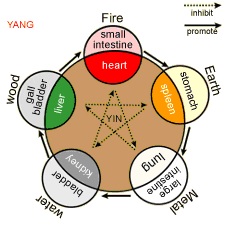
The pathogenic influences that alter the state of relative balance in the body and lead to disease are called etiological or causal factors.
Modern Western medical science attempts to isolate purely physical factors as the cause of disease. Bacteria and viruses, chemical compounds, and other external factors are blamed for most illnesses. The Chinese, however, view many of these “causes” merely as symptoms of the disease; because a certain organ is weak and unable to resist outside invasion, it is therefore prone to attack by an outside agent. Killing the agent eliminates the immediate symptoms of the disease but does nothing to restore the original qi (vital energy) of the diseased organ and tissues. It is only a matter of time before it succumbs to another attack.
TCM, however, attributes the cause of most diseases to external cosmological and internal emotional factors. These factors conform and act according to the principles of yin-yang and the five elements, which both stress balance and interconnectedness.
The external cosmological causes of disease are called the “Six Evils” and are governed by the meteorological conditions of season and climate while the internal emotional factors are called the “Seven Emotions” which are affected by our emotional response to different situations. The Huang Ti Nei Ching (The Yellow Emperor’s Medicine Classic) states: “The pathogenic evils either originate in yin or originate in yang; those coming from yang are related to wind, rain, cold, and summer heat; Those coming from yin are related to food and drink, living places, sexual life, and emotions such as joy and anger.”
The five elements and their relationships with nature and the body
| Wood | Fire | Earth | Metal | Water | |
| Orientation | East | South | Middle | West | North |
| Season | Spring | Summer | Late Summer | Autumn | Winter |
| Climate | Wind | Summer Heat | Dampness | Dryness | Cold |
| Cultivation | Germinate | Grow | Transform | Reap | Store |
| Yin Organ | Liver | Heart | Spleen | Lung | Kidney |
| Yang Organ | Gall Bladder | Small Intestine | Stomach | Large Intestine | Bladder |
| Orifice | Eye | Tongue | Mouth | Nose | Ear |
| Tissues | Tendons | Vessels | Muscles | Skin & Hair | Bones |
| Emotions | Anger | Joy | Pensiveness | Grief | Fear |
| Colour | Blue/ Green | Red | Yellow | White | Black |
| Taste | Sour | Bitter | Sweet | Pungent | Salty |
| Voice | Shout | Laugh | Sing | Cry | Groan |
Six Evils
What Are The Six Evils ?
The six climatic evils are:
※ Wind ※ Cold ※ Summer ※ Heat ※ Dampness ※ Dryness ※ Fire
They have the following pathogenic features:
The pathogenic features of the six TCM evils.
- They are related to the seasons or working environment
For example, generally there are wind diseases in spring, summer-heat diseases in summer, damp diseases in late summer and early autumn, dry diseases in autumn, and cold diseases in winter. In addition, people who live for a long time in a damp environment tend to be easily attacked by the damp evil, and those who work long in an environment of high temperature tend to be easily attacked by the dry-heat evil or fire evil. - All evils can work alone or in combination of two more in attacking the body
Such syndromes like the common cold of wind-cold type, damp-heat diarrhoea, and wind-cold-damp blockage are examples of medical problems caused by a combination of evils. - In the course of causing disease, any one of the six evils can influence the others and can also transform into another kind of evil under certain conditions.
For example, the cold evil that enters the body’s interior can be transformed into the heat evil, and the long-persisting summer-heat with dampness can be transformed into dryness evil. - The six climatic evils enter the body and cause disease mostly through the spaces located between skin and muscle, or the openings like nose and mouth. For this reason they are also termed the “six exogenous or outside evils”.
| Evil | Element | Season |
| Wind | Wood | Spring |
| Cold | Water | Winter |
| Summer-heat | Fire | Summer |
| Dampness | Earth | Late Summer |
| Dryness | Metal | Autumn |
Special Conditions
The Six Evils do not affect every person in the same way. Indeed, exceptionally healthy persons are not adversely affected by any of them. An “evil-excess” will attack the body only when and where it is weak and only when the protective-qi is deficient somewhere along the surface of the body. One of the purposes of preventive medicine is to keep the body resistant to such outside attacks.
Diseases of the six evils are most likely to occur under abnormal weather conditions, when the body is prepared for the dominant season and suddenly faces an opposite force. Sudden cold spells in mid-summer, for example often causes epidemics of influenza. Similarly, people who travel or move from a cold, dry place to a warm, damp climate are more vulnerable to invasion by local meteorological excesses than natives of the region.
Plague was a major problem during ancient time; therefore TCM learnt about epidemic diseases earlier and pestilential evils are blamed for it. The pestilential evil is a kind of pathogenic factor with intense infectivity. Attacks of pestilential evils are usually related to unusual climates such as droughts, floods, extreme heat as well as pollution. Epidemics occur suddenly with severe symptoms and are highly contagious.
Wind
Belongs to the element wood and dominates in spring. It is considered the leading evil. In the spring, the body is unaccustomed to the warm temperatures and the pores dilate easily, making it easier for evil-wind excess to enter the body. Suwen (The Book of Plain Questions) says, ” The wind evil can hide in the skin. It causes cold symptoms and sweating when the subcutaneous tissue is loosened, it causes heat symptoms but no sweating when the subcutaneous (means beneath the skin) space is closed.” Symptoms of “wind-injury” are coughing, stuffy or runny nose, headache, dizziness, and sneezing. Wind often combines with heat, “wind-heat”, or cold “wind-cold” depending on the weather, and such winds induce symptoms of both excesses. There is also an “inner-wind” unrelated to weather, which originates in the heart, liver, or kidneys due to energy imbalances. Symptoms of “inner-wind injury” are fainting, weakness, nervous spasms, blurry vision, and stiffness in the muscles and joints.
Characteristics of the Wind Evil:
- The wind is the leading evil of all diseases.
- The wind evil possesses a penetrating ability.
- Wind is characterized by constant movement, moveable and changeable.
- Upward and outgoing dispersion is a yang pathogenic factor.
- Wind, especially pathogenic wind occurs in gusts and is characterized by rapid change, giving rise to abrupt onset, migrating pain and fluctuating symptoms. For example, flare-ups of rheumatic joint pain and skin rashes are associated with wind evils.
Cold
Cold is associated with the element water and dominates in winter. Belonging to water, cold is a “yin-evil” which usually injures the body’s yang qi. If cold enters the exterior surface of the body, it produces symptoms of fever, aversion to cold, headache and body pains. If it reaches the meridians, it produces muscle cramps and pains in the bones and joints. If it enters as far as the internal organs, cold-excess causes diarrhoea, vomiting abdominal pains, and intestinal noises. “Inner-cold”, again not related to weather, is usually caused by a deficiency of yang-energy, in the stomach and spleen, inducing the internal cold symptoms of nausea, diarrhoea, coldness in the limbs and a pallid complexion. Excessive consumption of cold foods (“cold” in the sense of energy, not temperature) can also induce inner-cold. Some examples of cold foods are green tea, eggplant, tomato, celery, and barley.
Characteristics of the Cold Evil:
- Being a yin-evil, cold tends to impair yang-qi.
- It is the nature of cold to congeal and stagnate.
- It is the nature of cold to contract and shrink.
Summer-heat
Summer-heat belongs to the element of fire and is predominant during the summer season. Major symptoms of summer heat are excess body heat, profuse sweating, parched mouth and throat, constipation, and heart palpitations. When summer-heat combines with dampness, it produces abdominal pains, vomiting, and intestinal spasms.
Characteristics of the Summer Heat Evil:
- Summer-heat belongs to the yang evils; it is hot in nature.
- The summer-heat evil is characterized by ascension and dispersal; it can consume qi (vital energy) and impair body fluid.
- The summer-heat evil often mingles with pathogenic dampness.
Dampness
Dampness is associated with the element earth and is most active in late summer. Ailments of excessive dampness can be induced by sudden exposure to fog or mists, immersion in water or exposure to rain, and living in excessively damp locations of climates. The symptoms – lethargy, aching joints, and heaviness in the chest – are characteristically heavy and sluggish in nature and tend to block the flow of energy throughout the body. “Inner-dampness” is caused by excess cold consumption of liquor, tea, cold melons, and sweet, greasy foods. These impede spleen functions and cause symptoms of abdominal swelling, vomiting, and diarrhoea.
Characteristics of the Damp Evil:
- The damp evil is related to heaviness and turbidness.
- The damp evil belongs to the yin evil, and it tends to disturb the functional activities of qi (vital energy) and injure the yang-qi.
- Dampness is characterized by stickiness and stagnation.
- Dampness tends to descend and attack the yin sites of the body.
Dryness
Dryness belongs to the element Metal and dominates in autumn. Two types are distinguished “cold-dryness” and “hot-dryness”, depending on other conditions. Excessive dryness easily injures the lungs, causing symptoms of heavy coughing, blood in the sputum, dry nose and throat, and pains in the chest. Dryness evil is also harmful to the body’s fluid balance. “Inner-dryness” is caused by excessive loss of fluids due to too much sweating, vomiting, bleeding, and diarrhoea. Use of herbal medicines, which induce sweating, vomiting, or purging of the bowels, can also induce inner-dryness. Characteristic symptoms are dry, wrinkled, or withered skin, dry hair and scalp, dry mouth and cracked lips, dry stomach and hard, dry stools.
Characteristics of the Dry Evil:
- Dryness has a drying and puckering nature, and tends to impair the body.
- Dryness tends to impair the lungs.
Fire
When any of the five evils become too extreme, they often transform to become fire-evil. The symptoms are usually more intense forms of those associated with the original evil, plus symptoms of extreme heat. “Inner-fire” can also be caused by excessive emotional activity or by over-indulgence in food, drink, and sex. Violent anger, for example, often causes a sensation of heat rising from the upper abdomen, where liver-fire is raging. Too much strong food and drink causes fire to collect in the stomach; while deep grief or passion will often cause it to rise to the lungs.
Characteristics of the Fire Evil:
- Pathogenic fire-heat is one of the yang evils and it flames upwards in the body.
- Fire is likely to consume qi (vital energy) and impair the body fluid.
- Fire may produce wind and stir up the blood.
- Fire is likely to cause sores and ulcers.
Seven Emotions
What Are The Seven Emotions ?
The seven emotions are:
※ Joy ※ Anger ※ Anxiety ※ Pensiveness ※ Grief ※ Fear ※ Fright
Suwen (The Book of Plain Questions) says “The five yin-organs of the human body produce five kinds of essential qi, which bring forth joy, anger, grief, worry, and fear.” TCM also believes that certain organs are related to emotional activities, i.e. the heart is related to joy, the liver to anger, the spleen to pensiveness, the lungs to anxiety and the kidneys to fear.
The emotions are considered the major internal causes of disease in TCM. Emotional activity is seen as a normal, internal, physiological response to stimuli from the external environment. Within normal limits, emotions cause no disease or weakness in the body. However, when emotions become so powerful that they become uncontrollable and overwhelm or possess a person, then they can cause serious injury to the internal organs and open the door to disease. It is not the intensity as much as the prolonged duration or an extreme emotion, which causes damage. While Western physicians tend to stress the psychological aspects of psychosomatic ailments, the pathological damage to the internal organs is very real indeed and is of primary concern of the TCM practitioner.
Excess emotional activity causes severe yin-yang energy imbalances, wild aberrations in the flow of blood, qi (vital energy) blockages in the meridians and impairment of vital organ functions. Once physical damage has begun, it is insufficient to eliminate the offending emotion to affect a cure; the prolonged emotional stress will require physical action as well. The emotions represent different human reactions to certain stimuli and do not cause disease under normal conditions.
The Pathogenic Features of the Seven Emotions:
- Directly impairing organ qi (vital energy)
- Affecting the functions of organ qi (vital energy)
- Deteriorating effects of emotional instability
Joy
In TCM joy refers to a state of agitation or overexcitement.
“When one is excessively joyful, the spirit scatters and can no longer be stored,” states the Lingshu (The Vital Axis). However, in TCM, joy refers to a states of agitation or overexcitement, rather than the more passive notion of deep contentment. The organ most affected is the heart. Over-stimulation can lead to problems of heart fire connected with such symptoms as feelings of agitation, insomnia and palpitations.
Anger:
Anger could lead to high blood pressure.
Anger, as described by TCM, covers the full range of associated emotions including resentment, irritability, and frustration. An excess of rich blood makes one prone to anger. Anger will thus affect the liver, resulting in stagnation of liver qi (vital energy). This can lead to liver energy rising to the head, resulting in headaches, dizziness, and other symptoms. In the long run it can result in high blood pressure and can cause problems with the stomach and the spleen. It is commonly observed that ruddy, “full-blooded” people with flushed faces are more prone than others to sudden fits of rage at the slightest provocation.
Anxiety:
Anxiety can block the qi and manifest in rapid, shallow breathing.
“When one feels anxiety, the qi (vital energy) is blocked and does not move.” Anxiety injures the lungs, which control qi (vital energy) through breathing. Common symptoms of extreme anxiety are retention of breath, shallow, and irregular breathing. The shortage of breath experienced during periods of anxiety is common to everyone. Anxiety also injures the lungs’ coupled organ, the large intestine. For example, over-anxious people are prone to ulcerative colitis.
Pensiveness
Too much intellectual stimulation can cause pensiveness.
In TCM, pensiveness or concentration is considered to be the result of thinking too much or excessive mental and intellectual stimulation. Any activity that involves a lot of mental effort will run the risk of causing disharmony. The organ most directly at risk is the spleen. This can lead to a deficiency of spleen qi (vital energy), in turn causing worry and resulting in fatigue, lethargy, and inability to concentrate.
Grief
Grief that remains unresolved can create disharmony in the lungs.
The lungs are more directly involved with this emotion. A normal and healthy expression of grief can be expressed as sobbing that originates in the depths of the lungs – deep breathes and the expulsion of air with the sob. However, grief that remains unresolved and becomes chronic can create disharmony in the lungs, weakening the lung qi (vital energy). This in turn can interfere with the lung’s function of circulating qi (vital energy) around the body.
Fear
Fear that cannot be directly addressed is likely to lead to disharmony in the kidneys.
Fear is a normal and adaptive human emotion. But when it becomes chronic and when the perceived cause of the fear cannot be directly addressed, then this is likely to lead to disharmony. The organs most at risk are the kidneys. In cases of extreme fright, the kidney’s ability to hold qi (vital energy) may be impaired leading to involuntary urination. This can be a particular problem with children.
Fright:
Fright can affect the kidneys if left unchecked.
Fright is another emotion not specifically related to only one organ. It is distinguished from fear by its sudden, unexpected nature. Fright primarily affects the heart, especially in the initial stages, but if it persists for some time, it becomes conscious fear and moves to the kidneys.
Other Etiological Factors
While the main causes of body disharmony are external like the six evils or internal like the seven emotions, there are additional factors that need to be taken into consideration in disease causation. These factors are constitutional factors, lifestyle factor and unforeseen factors.
Constitutional Factors
TCM maintains that an individual’s energy system are comprised of inborn qi and jing produced throughout life. Inborn qi represents our constitution, which depends on our parents. If inborn qi is deficient, the individual is more susceptible to the whole range of external and internal factors, which can possibly cause a disharmony. Therefore, if we believe that we have any constitutional weakness, we need to take particular care to ensure that any other potential causes of disharmony in our lives are avoided if at all possible.
Lifestyle Factors
TCM has always recognized the importance of “lifestyle factors” in the maintenance of good health and well being. This now has become the focus of Western medicine.
- Work
The kind of work we do, or lack of it if unemployed, can profoundly influence our energy system. Too much physical work can impair the qi (vital energy), and with excessive lifting the lungs become deficient. Too much mental activity can damage the spleen and make the yin deficient. Someone who works outdoors, for example, is more liable to be at risk from cold, dampness, wind or heat evils.
- Exercise
Exercise, if undertaken to an extreme can cause disharmony. For example, many athletes, who train to an excessive degree, appear very fit, but are often very susceptible to infections and injuries. In the long run they may become chronically qi (vital energy) deficient because of overstressing the kidneys. It will be noted that many Chinese exercise regimes such as qi-gong or taijichuan are not obviously aerobic in nature like many Western forms of exercise. These practices however, offer a more balanced approach to exercise consistent with the principles of TCM. It is evident that good health and longevity are notable in the practitioners of such activities.
- Diet
Diet is afforded a very important place in Chinese medicine. See Chinese Functional Foods. The stomach and spleen have the responsibility for processing food and extracting the nutrient essence, which is then passed onto the lungs as a central part of the production of qi (vital energy) in the body. If the spleen has to work against poor and damaging foods, then it will suffer (especially from damp) and the body will deplete the qi (vital energy) of the body as a whole.
Balance rather than specific dietary instructions represents the Chinese approach to nutrition. If an individual follows a healthy and balanced diet, then the spleen will remain healthy and the qi (vital energy) of the body will be sufficient. The overemphasis on sweet and processed foods in many Western diets does not lend itself to such a balance.
- Sexual Activity
In TCM, excessive sexual activity is considered to be damaging to kidney jing and can lead to long-term deficiency problems. An excessive number of pregnancies can seriously deplete a woman’s blood and jing. While there is much debate about what is considered excessive sexual activity, the Chinese system generally emphasizes a natural decline in this activity as part of the ageing process.
Special Pathological Conditions
During the course of illness, some pathological products are formed; they can in turn act directly or indirectly on certain tissue or organs, and cause new pathological conditions. The above mentioned five inner evils (wind, cold, dampness, dryness and fire evils) create these kind of changes. Retention of phlegm, static fluid and blood stasis are other commonly developed conditions.
- Retention of phlegm and static fluid
These are attributed to disorder in fluid metabolism, phlegm is thick and turbid, static fluid is thin and clear. The fluid metabolism is managed by the lungs, spleen, kidneys, and triple burner. When these organs are affected by the six evils, diet or seven emotions, they under-function and fluid metabolism is disturbed, which in turn causes the detention of water and body fluid.
- Blood stasis
Blood stasis refers to general non-smooth blood circulation, or localized stagnated blood flow, or blood exudates from the vessels that fail to disperse. Blood stasis is usually caused by qi (vital energy) deficiency, qi (vital energy) stagnation, or cold evil or heat evils attacking the blood. Features of blood stasis are characterised with stabbing pain, cyanosis, tumour, bleeding (dark purplish blood with clotting), dark complexion, dry skin, purplish dark tongue with tiny bleeding spot, and a thready and uneven pulse.
Unforeseen Events
This last category includes accidents and injuries, which affect the qi (vital energy) of the body depending on their type and severity. In addition, other problems such as pollution and contamination of food can readily be placed in this category.
Conclusion
In Chinese medical theory, all diseases have a definite cause, either internal or external in origin. Of the two, internal factors are more important because it is internal weakness, which first permits invasion by external forces of excess. A strong, healthy, well-balanced body and mind will resist attack from even the most extreme environmental factors. This again explains the stress that TCM places on basic preventative care through diet, exercise, breathing, regulated sex, and preventative herbal prescriptions. It has only been in the past few decades that Western medicine has started to follow suit and incorporate some TCM concepts into its practice.

